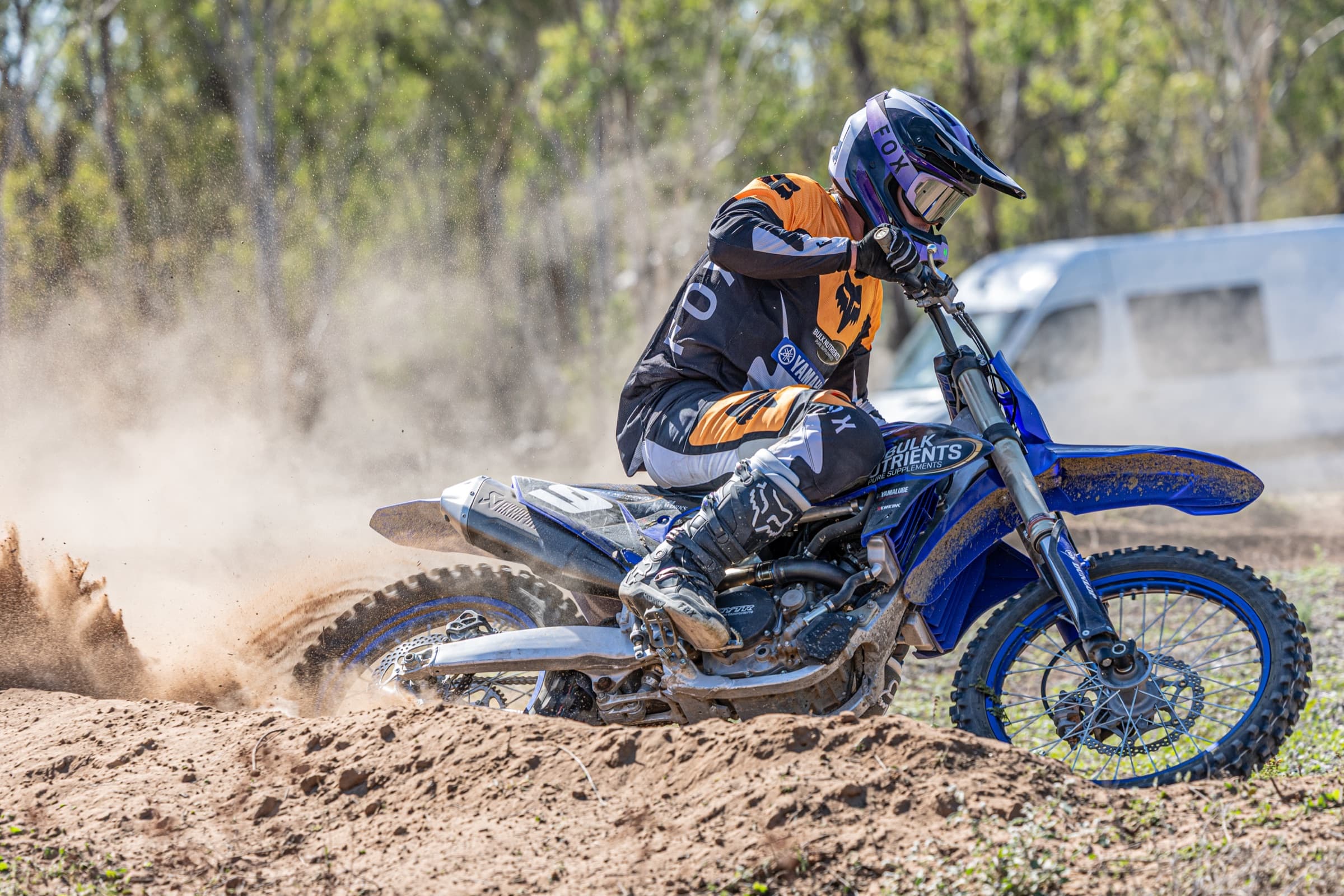
Coaching
Faster
on purpose
Most riders do not get slower because they lack talent — they get stuck because nobody has ever stood on the outside of a corner and told them the truth. That is what a session with me is.
The Four
LINE · BODY
BIKE · HEAD
Every assessment, every session, every plan uses the same four headings. Each one is scored 1 to 5 on every sub-skill, written down, dated, and shown to you.
LINE
Where the bike goes
Are you riding the fastest way through this piece of track, or the way you always have?
Braking points, entry line, apex and rut selection, exit drive, and reading the track as it breaks up.
BODY
What you do on the bike
Is the bike working with you, or fighting you?
Standing and seated position, transitions, vision, grip, knee drive, absorption and timing.
BIKE
What is underneath you
Have you removed the excuses before you ride?
Sag, clickers, tyre pressures, lever and bar position, gearing and delivery, pre-ride discipline.
HEAD
Everything above the neck
Do you ride the same in moto two as you do in practice?
Starts, pressure, fear and progression, fatigue decisions, race craft and preparation routine.
The scale
1
Unsafe / absent
Cannot do it yet, or does it in a way that will hurt them.
2
Aware but inconsistent
Can do it when reminded, at low speed. Falls apart under pace.
3
Reliable at pace
Holds it for a full lap at riding pace. Breaks under race pressure.
4
Automatic
Holds it in a moto, when tired, without thinking.
5
Weaponised
Uses it to gain time or make passes. A strength, not a competency.
I do not inflate scores. A 3 called a 4 to make a parent feel good destroys the only thing this is built on.
Coaching
Opening soon
Sessions are not open for booking yet.
Coaching in Australia has to run under a Motorcycling Australia accreditation and a permit — that is what makes a session insured for you and for me. I am not going to advertise sessions before that is in place, so dates and pricing go up the moment it is.
Register below and you will hear first. In the meantime the ride days are open to everyone.
Start here · free
The Honest Lap
A filmed, scored assessment of your riding. Free, and you keep the card.
How it runs
- Setup
- Four cones in an 8 m square, on any flat ground.
- Kit
- Your bike, four cones (or four buckets), and a phone on a fence post.
- Time
- Under 10 minutes of riding
- 01Static walk-around — you film your own bike and call out sag, levers, bars and pressures
- 02Standing lap — three laps of the square, figure of eight, standing throughout
- 03Seated lap — three laps, seated through the turns, transitions visible
- 04Brake box — accelerate to the far cone and stop with the front wheel in the box, three attempts
- 05Thirty seconds to camera — what you think your biggest problem is
What comes back
- A scored JC111 Four card, dated, that you keep
- Two named problems, each with the mechanism and a drill
- A voice note walking you through the footage
A backyard lap scores BODY and BIKE properly, and part of LINE. HEAD and most of LINE cannot be assessed from a square in a paddock — those come back marked “not assessed”, and I will say so.
Send me an Honest LapHow a session runs
Five stages, every time
- 01
BEFORE
15 min
Sit-down. What you ride, what you race, what is frustrating you, and what you think your problem is — written down in your words. Then the bike check, done with you rather than for you.
- 02
FIRST LAPS
20 min
The Honest Lap, filmed from three positions. No coaching. Not one word. I cannot diagnose a habit I have already interrupted, and you need to see your own normal riding on video.
- 03
HONEST FEEDBACK
20 min
Video review, sitting down, out of the sun. I name The Two Things — the two biggest sources of lost time. Not five. Two. Each with the mechanism and the drill.
- 04
DRILL WORK
3 × 40 min
Isolate, overwrite, layer, integrate. High reps on the two things, with feedback every time you come past. If it did not change today, you get told that honestly.
- 05
FOLLOW-UP
Within 48 hrs
The Four-Week Plan, written and sent. What to practise, how many reps, what success looks like, what to film, and the date to re-shoot your Honest Lap.
What you take home
Four things, on paper
A session that ends with a handshake and a good feeling is a session you cannot measure. You leave with four things instead.
The JC111 Four Card
On the day, on paper
Scored 1–5 across every sub-skill assessed, dated and signed, with the two named problems circled. You keep it. Next time we score it again beside this one.
The footage
Within 24 hours
Raw clips from every camera position, plus the two or three clips we used in the review. It is yours.
The Four-Week Plan
Within 48 hours
Two focus items, the drills with reps and success criteria, a week-by-week build, and the date to re-shoot the Honest Lap.
The bike sheet
On the day, on paper
Sag, clicker positions, tyre pressures and lever positions — as found and as set. Nobody else hands this out, and it means you can always get back to a known baseline.
Safety
The rules I will not bend
These are not disclaimers. They are the four things that decide whether a coaching day is safe, and every one of them is checkable on the day.
Never more than six riders per coach
Six riders solo, or twelve with a second coach in two groups of six. This is not a marketing number — it is the Motorcycling Australia ratio for a Level 0 or Level 1 coach working alone, and exceeding it voids the insurance for everyone on the track. Count heads at 9 am.
The forgiving jump rule
I will only coach you on a jump you could come up three to six metres short or long on and still land safely. Everything bigger waits until the scores say you are ready and you have asked for it.
The curriculum is gated
Nothing gets taught until the skill underneath it is scored. Jumping needs standing position, absorption and braking each at 3. Whoops need 4s. “I am not coaching you that yet” is a complete sentence, and it is often the most valuable thing I say all day.
A frightened rider does not get pushed
Fear of a feature usually means the rider knows they are not ready for it, and that is a correct assessment. We go back two rungs and rebuild. Whatever the day costs, and whoever asks.
For parents
The parent policy
Given out loud before every junior session and printed on your booking confirmation, so there are no surprises.
- 01The rider is the client. Feedback is given to the rider. You are welcome to listen.
- 02One voice on the track. During drill blocks I am the only person giving instruction. No coaching from the fence — it is confusing for the rider and unsafe.
- 03You get your own five minutes at the end of the day, without the rider, to ask whatever you want to ask.
- 04From age 12 the four-week plan goes to the rider's email as well as yours.
- 05We will tell you if we think your kid does not want to be here. Politely, privately, once.
- 06We will not coach a frightened rider onto a bigger jump, whatever the day costs and whoever asks.
Feedback
Nothing here yet
No reviews, because no one has been through yet.
When they have, what appears here will be what riders and parents actually wrote on the feedback form at the end of the day — first name only, in their words, and only where they ticked the box that says we can use it. Nothing written by me, and nothing tidied up.
The number worth watching is not a star rating. It is how many riders book a second time, and that gets published as soon as there is a big enough sample to mean anything.
Affiliation & cover
Who sanctions it
Australian off-road sport has two independent sanctioning bodies. Coaching accreditation sits with Motorcycling Australia's NCAS framework; AMCA is an alternative path for events and racing. Cover follows the permit either way.
MA / MV
Motorcycling Australia
State body: Motorcycling Victoria
Cover placed with
MA Insurance Limited (MAIL), under the National Insurance Programme
- The NCAS coaching accreditation framework — Club Coach, Level 1, Level 2
- Public liability cover for permitted events, reported at $40 million
- Professional indemnity cover extending to accredited coaches
- Free come-and-try recreational licences for new riders
- Nationally recognised rules via the Manual of Motorcycle Sport
Cover applies only to activity run under an MA or SCB permit. Coaching requires accreditation under the NCAS framework.
MA / MV website →AMCA
Australian Motorcycling Competition Association
Cover placed with
Galvaniize Insurance, under the AMCA National Insurance Framework
- An independent sanctioning path for competitive off-road events
- Personal accident cover under the AMCA National Insurance Framework
- Annual race licence and affiliated-club event structure
- Affiliated clubs run both racing and recreational ride days
AMCA states it is not a licensed insurer or broker — cover is placed through Galvaniize. Income protection is not included; riders should arrange their own.
AMCA website →Ask any coach which body they are accredited with and whether your session is permitted. If either answer is vague, you are not insured — and that applies to me as much as anyone else.
Book
Get a session in the diary
Tell me what you ride and where. I will come back with dates and a price, usually inside a day or two.
Before you book
- Any level. First-season juniors through to riders chasing a plate. Tell me honestly where you are at.
- Any Yamaha, or anything else. I race a 250 in MX2 and a 450 in MX1, so it does not matter what you turn up on.
- Bring a bike you trust. If the bike is unsafe we will spend the session fixing it instead of riding it — and the bike check is part of the day anyway.
- No licence, no ride. A current MA licence or a purchased single-event licence has to be shown on the day. There is no way around this one.
- Wet weather. Mud is part of racing. We only move a session if the venue closes the track.